Why are we debating the same choice again?
A fresh session finds a cache but no explanation for its five-minute lifetime. It changes the lifetime to a day, and an old problem returns. Code reveals the implemented choice; the constraints behind it may be missing.
Other costs live outside the code: following obsolete instructions, searching the wrong documents and repeating manual checks. This lesson preserves durable reasoning and turns session evidence into one testable environmental improvement.
Code is the materialized view of all the decisions made
— Matt Pocock
Use an ADR for a decision that still needs explaining
Record context, choice, rationale, consequences and status in an architecture decision record. Manage temporary execution steps separately. When a decision changes, identify its replacement so a reader can distinguish historical reasoning from the current agreement.
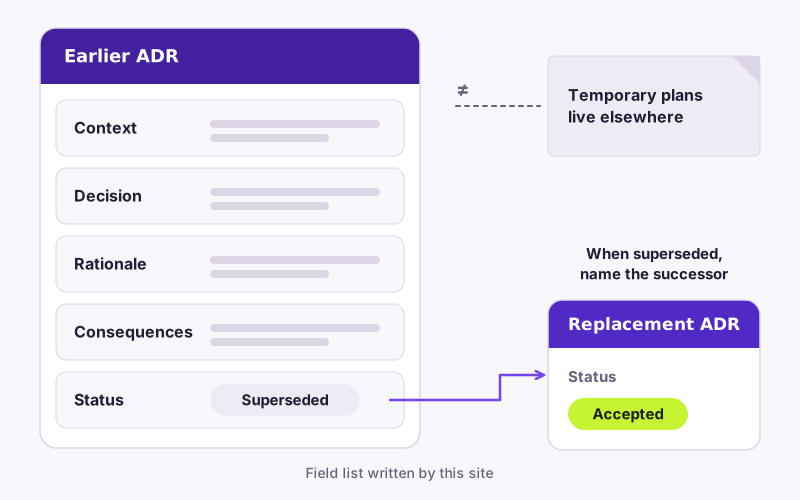
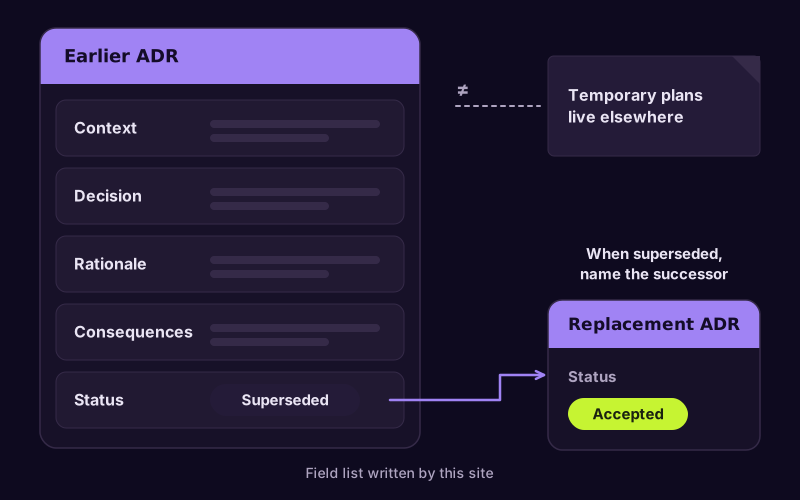
Context and choice
What constraints mattered, and what was selected?
Rationale and consequences
What alternative was set aside, and what cost was accepted?
Status
Is this current, undecided or superseded by a named record?
This field list is ours. Use the team's review and change process to maintain it; another person's committing habits are not a requirement. Update durable reasoning separately from current task progress.
Start a retrospective with observed evidence
/retro examines real sessions and review feedback: slow document discovery, stale references, missing tools and missing checks. Successful delivery can still contain expensive detours, so inspect successful sessions too.
Connect each observation to a minimal improvement and a way to verify it. A person confirms the change before it becomes policy. Prefer repairing navigation or a definite check when that addresses the evidence.
A glossary needs an active checking step
A business term may name different things for different readers. Record its meaning, confusing alternatives and relationships. Then check a ticket or report against those entries. A general request for consistent language gives no observable result by itself.
Matt withdrew one experiment with a passive style instruction. That does not establish that all writing requirements fail. Identify a real ambiguity, name the terms to check and compare how readers understand the revised text.
Exercise: produce a record and a proposal
Explain the cache and repair the route to its documentation
- Fictional site example: a session read an obsolete interface guide; two failed runs preceded discovery of the current guide.
- Confirmed decision: status may lag by at most five minutes, so cache for five minutes and accept more requests.
- Task: Write a five-field ADR, then propose one retrospective improvement and its verification.
Suggested approach
Record the latency constraint, five-minute choice, rationale, request cost and current status. Propose redirecting the status-interface pointer after human confirmation and marking the old guide superseded. Ask a fresh session to locate the interface and observe whether it reaches the current guide directly.
Done means both outputs can be assessed
The ADR explains an accepted cost and identifies its status and replacement, if any. The proposal points to session evidence, a minimal change, a confirming person and a verification action. An unapproved proposal remains a proposal.
For a lasting rule, use standards and checks to choose where it should run.
Quick reference
ADR
Keep durable context, choice, rationale, consequences and status.
Retrospective
Evidence → minimal improvement → verification → human confirmation.
Glossary
Define the language and check real documents against it.
Sources
- Matt Pocock, code and decisions, 2026-10-06.
- Matt Pocock, retro prompt, 2026-10-02; independently interpreted.
- Matt Pocock, withdrawn style experiment, 2026-08-07; independently interpreted.
- The ADR fields, development record and answer are ours. Copyright details.
Unofficial, non-commercial study notes, with no affiliation with or endorsement by Matt Pocock. Quoted works belong to their authors; MIT reuse carries separate copyright and licence notices.