The reminder is there. The mistake keeps returning.
Review finds another domain module importing a UI component. Last time, someone added “watch import direction” to the instructions. A person still has to catch the same mistake. First decide whether the rule has a mechanically checkable answer.
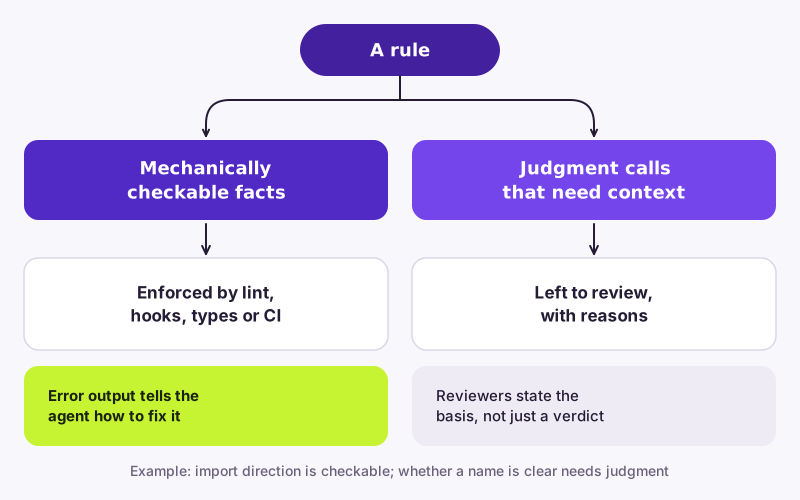
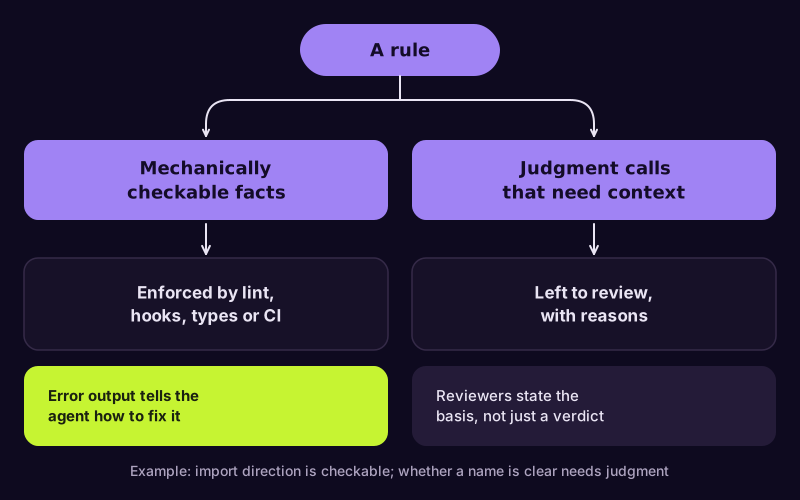
Natural-language reminders spend judgement on a repeatable fact. Other questions, such as whether an abstraction earns its complexity, depend on context and need a reasoned review.
Make definite failures actionable
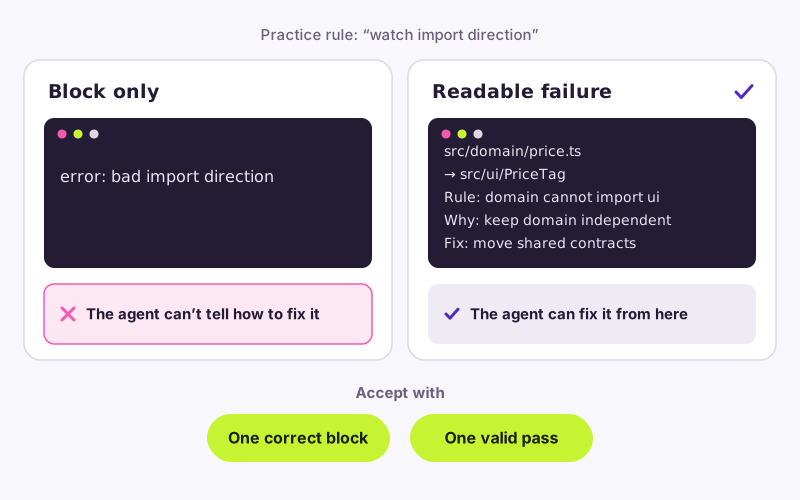
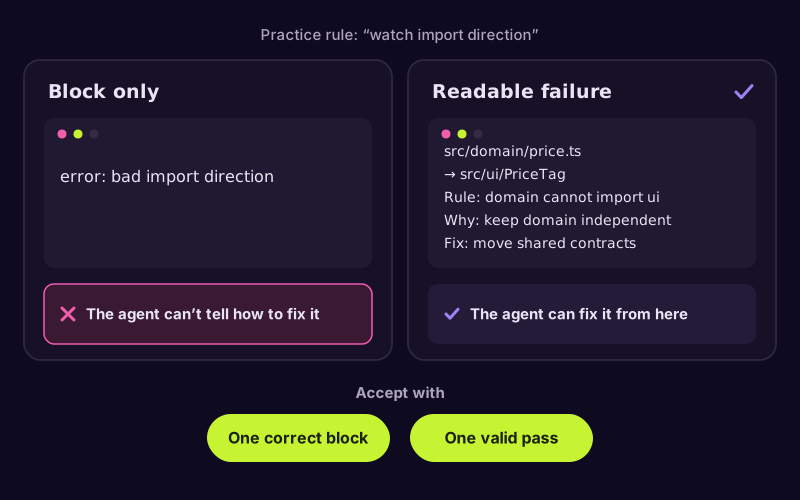
Use lint, hooks, types or CI for rules such as dependency direction and required fields. Pick a tool that covers the actual risk. Its failure output should identify the location, rule, reason and route to a fix.
IMO a deterministic rule should be enforced deterministically
— Matt Pocock
Try one forbidden input and one permitted input. A tool finishing successfully does not establish that it inspected the intended files. Observe both a correct rejection and a legitimate pass.
Write standards around target behaviour
Use CODING_STANDARDS.md for conventions learned from actual failures. Make the heading state the required behaviour, explain why, and identify rules already enforced by tools. AGENTS.md provides the navigation to this material.
Keep context-dependent rules in review with their rationale. Moving more standards to review is one of Matt's ways to reduce implementation-time instruction load. Necessary task constraints, authority boundaries and platform requirements must still be available when needed.
A threshold does not define a module
Matt's personal examples include a 5,000-token file threshold, estimating tokens with bytes divided by four, and keeping a hook under three seconds. These are working parameters, not universal project limits.
A byte estimate is not a tokenizer measurement. Chinese text needs separate measurement. A file is not necessarily a module either: preserve coherent responsibilities and interfaces when splitting code instead of fragmenting a concept to satisfy a number.
Exercise: make a failure point toward a fix
Turn “watch import direction” into a check
- Our scenario: src/domain may not import src/ui. Dependencies in the opposite direction are permitted.
- Task: Define coverage, a forbidden import, a permitted import and the failure message.
- Forbidden: src/domain/price.ts imports src/ui/PriceTag.
- Permitted: src/ui/PriceTag.ts imports src/domain/price.
Suggested approach
Inspect actual domain dependencies and resolve aliases before checking whether their destinations are in ui. Report the source file and import path, explain domain independence, and suggest moving a shared contract somewhere both sides may depend on.
Done means the check distinguishes the cases
Run the forbidden example and observe a nonzero exit with a useful diagnostic. The permitted example should exit successfully. Check coverage and path aliases so an alternative spelling cannot bypass the boundary.
Use decisions and retrospectives to assess the result before expanding coverage.
Quick reference
Definite facts
Enforce with tools and explain how to repair failures.
Contextual choices
Review them with a stated rationale.
Effectiveness
Observe both correct rejection and legitimate passage.
Sources
- Matt Pocock, deterministic enforcement, 2026-10-18.
- Matt Pocock, a file-size threshold example, 2026-10-18; independently interpreted.
- The check scenario, diagnostic and exercise are ours. Copyright details.
Unofficial, non-commercial study notes, with no affiliation with or endorsement by Matt Pocock. Quoted works belong to their authors; MIT reuse carries separate copyright and licence notices.