Start with the problem on your desk
You have saved tutorials and tried new tools, yet a real project still leaves you wondering what to do next. These notes offer a starting point for that moment: identify one obstacle and work toward one observable result.
A reading list becomes useful when it changes what you do. Each lesson asks you to make a choice, try something small, and check the outcome.
A teacher who moved into development
Matt Pocock moved from voice teaching into software development. His public work has covered XState, TypeScript education, AI engineering, and agent workflows. Those areas provide the context for these notes.
This site pays tribute to his teaching and public sharing. We study how problems are framed, explanations are built, and feedback informs the work. The lessons and exercises here are independently written by the maintainers.
I poured my 10 years of teaching experience into a skill.
— Matt Pocock
That line describes the author's investment in his work. Whether a teaching approach helps you is a separate question, best tested by completing an unfamiliar task yourself.
Go directly to the author
Explore his X account, GitHub, and AI Hero. Open the originals when you need context or want to check a date.
These are unofficial, noncommercial study notes. Read About and Copyright for the distinction between quotations, our commentary, and licensed reuse.
Choose the obstacle you recognize
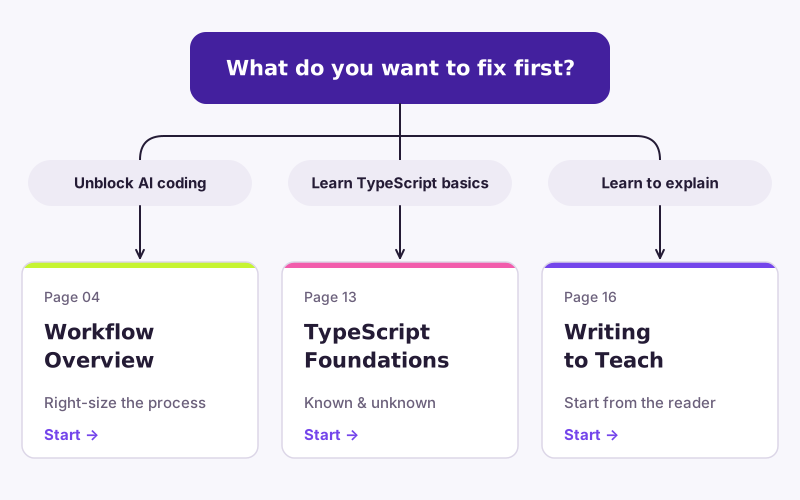
Think of a recent task that stalled. Did the agent build the wrong thing? Did a type error stop you? Could you solve the problem but struggle to explain it? Pick the route closest to that experience.
AI coding
Use the workflow overview to choose the steps your task needs.
TypeScript
Start with foundations to practice checking data and understanding types.
Teaching
Try writing to teach to turn one idea into a lesson someone can use.
Make your first choice testable
Choose an outcome for today's reading
- Task: name a real obstacle and select one route above.
- Deliverable: write one sentence describing a small task you want to complete afterward.
- Check: name an observable result, such as reproducing a failure and verifying its repair.
Suggested approach
If an agent built the wrong behavior, choose the workflow route. Aim to produce agreed behaviors and a separate list of unresolved questions.
You are ready to begin when you can name a page, an action, and the evidence that will count as success. If that feels vague, narrow the task to one operation or one error.
Corpus: find the original
The corpus is a continuing index of selected public work. Records carry links, dates, types, tags, engagement figures, and summaries written for this site. Follow a record to read its source.
Quick reference
Pick a problem
Start with today's obstacle and one route.
Produce evidence
Complete a small task to check what you learned.
Check context
Read source dates and distinguish quotations from our judgments.
Sources
Independent, unofficial, noncommercial study notes. This site has no affiliation with or endorsement from Matt Pocock. Referenced works belong to their authors; MIT reuse carries separate copyright and license notices.