Where criticism can stall
Someone says a rule does not work. You immediately defend it. Someone else shares a useful method, and your retelling drops their name. Both responses remove opportunities to learn together.
Address the issue, then ask for context
Replies in the research sample are often brief and direct. The useful habit is answering the specific issue before asking about the environment, steps and expected outcome. Forceful wording adds no evidence.
Ask which step failed to produce the expected result. A reproducible failure becomes an improvement candidate. When details are missing, keep the uncertainty visible and request the conditions needed to investigate.
Negative feedback is a gift! Would love to know how to make the skills better.
— Matt Pocock
A like, a successful screenshot or one failure does not establish general effectiveness. Record the conditions first, then check whether a proposed change resolves the reported problem.
Credit recommendations and adaptations
When recommending a skill, keep its author and original link. When adapting it, identify what you reused and what you changed. MIT reuse also requires the accurate copyright notice and full licence; a thank-you list cannot replace them.
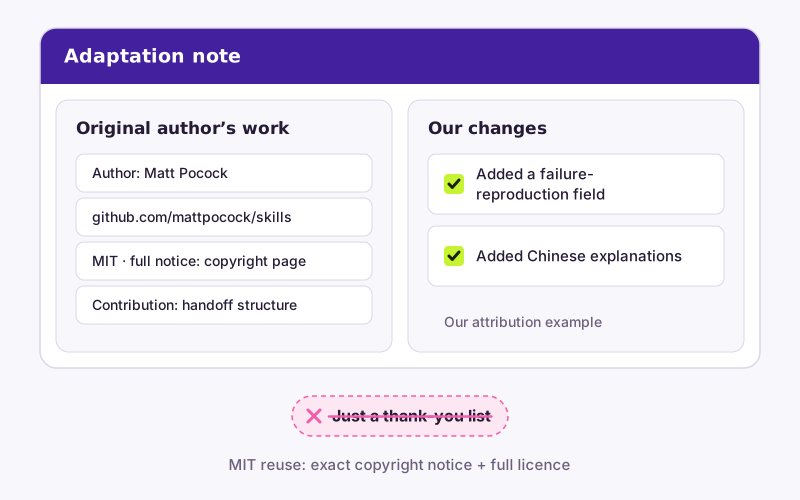
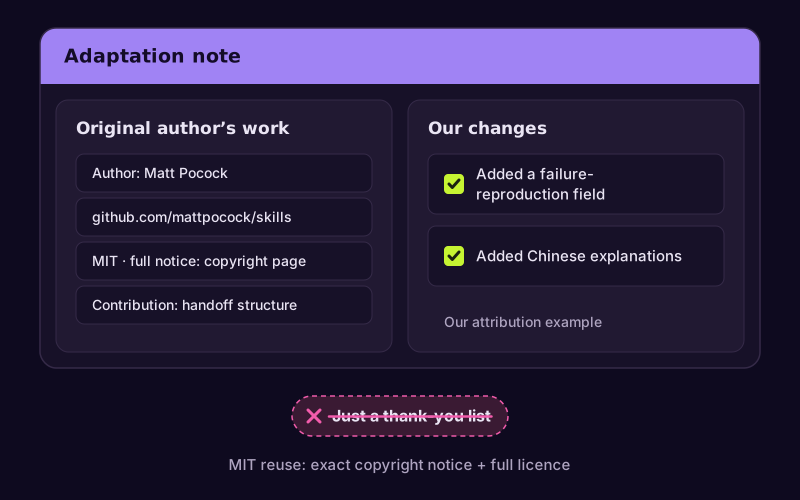
Our original attribution example: the author supplied a handoff structure; this site added a failure-reproduction field and Chinese explanations. Distinguishing those contributions lets readers check the source. See the copyright page for licence details.
Revise experiments when evidence changes
The research records a change: after publishing a passive ASD-STE100 instruction, Matt reported that it had not worked. This is a paraphrase of the experiment's outcome, with no additional quotation. The lesson is to update a judgement when evidence changes.
The archived replies mainly cover 2026-04-20 through 2026-10-20; earlier coverage is incomplete. Patterns in that sample cannot represent every reader or his entire history, and cannot validate results in your project.
Exercise: answer two criticisms
Leave the discussion a useful next step
- Situation one: someone only says the rule is useless. Request actionable details.
- Situation two: someone provides failure steps. Explain how you will reproduce and report back.
- Credit check: retain the contributor, source and your changes when a suggestion comes from someone else.
Suggested approach
First request the task, steps, expected result and actual result. Then reproduce supplied steps and report reproducibility, scope and recheck results. State when the evidence is still insufficient.
Done means each reply requests or produces evidence without promising an unverified fix. Any retold method remains traceable to its contributor. Take concrete improvements into decisions and retrospectives.
Quick reference
Respond
Address the specific issue and what is currently known.
Verify
Gather context, reproduce and record limits.
Attribute
Identify author, link, licence and your changes separately.
Sources
- Matt on negative feedback, 2026-09-07
- Follow-up on the tone experiment
- skills, an entry point for checking authorship and licensing
- Site copyright and source notes
Unofficial, non-commercial study notes. No affiliation with or endorsement by Matt Pocock. Quoted works remain their authors’ copyright; MIT reuse retains its copyright and licence notices.