More code, more rework
An agent changes several files, but the feature still misses the point. Before changing models, locate the failure: a mistaken goal, missing information, a verification gap, or a design that makes errors easy. Each calls for a different intervention.
Delivery starts a maintenance obligation
Generation speed explains how code arrives. It says little about the next person who must change it. Duplicate implementations, unused branches, and unclear interfaces all make that next decision harder.
Ask what observable behavior a piece of code serves. Which acceptance criterion would fail if it disappeared? If nobody can answer, establish the requirement before deciding whether to keep the implementation.
If your code sucks, your agent will too.
— Matt Pocock
Give a collaborator a workable environment
An agent needs a way into the project: reliable navigation, shared domain terms, a runnable application, and usable feedback. Repeating a request for care cannot supply a missing fact.
Wrong goal
Return to alignment and agree on behavior.
Missing information
Improve document navigation and domain language.
Verification gap
Build a feedback loop.
Design defect
Examine states and module boundaries.
An improvement must handle the failing input correctly and keep the valid path working. Hiding the failure or rejecting every request would fail that test.
Exercise: success without configuration
A submission form displays a sent confirmation even when its service address is missing. Predict whether one more reminder to check configuration would prevent recurrence. Then describe a repair at each of the four layers below.
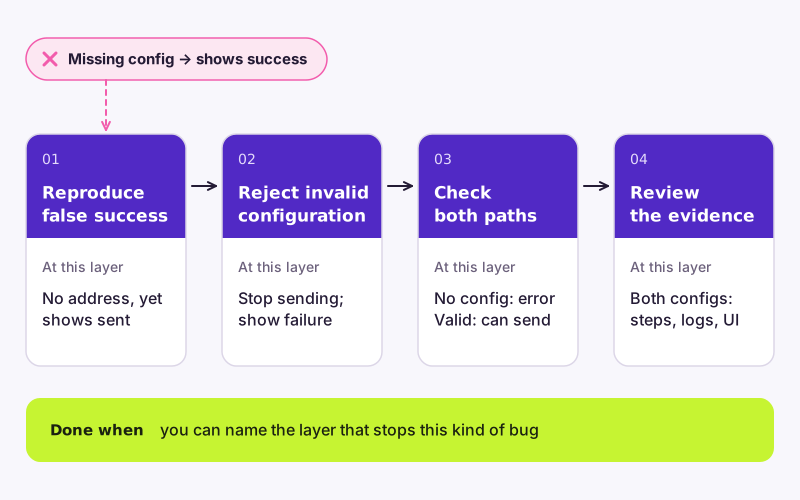
Make false success visibly fail
- Task: submit with the service address missing and record the incorrect confirmation.
- Boundary: stop the send operation on invalid configuration and return an explicit failure.
- Check: missing configuration produces an error; valid configuration still permits sending.
- Review: provide the steps, logs, and visible results for both configurations.
Suggested approach
The boundary rejects invalid configuration, a behavior check catches a returning false confirmation, and review examines evidence from actual operation. State what each layer catches.
What counts as done?
Deliver a reproducible failure, a repair at the responsible boundary, and a passing result. Another reader should be able to identify where the same mistake would be stopped next time. Relying on an agent's memory leaves that question unanswered.
Also examine the valid request. Did the repair introduce unexplained branches or duplicate an entire implementation? Include the resulting maintenance burden in the discussion.
Quick reference
Classify first
Distinguish goals, information, verification, and design.
Keep useful code
Judge delivered behavior and the cost of changing it.
Rerun both paths
Make failure visible and preserve valid behavior with reviewable evidence.
Sources
Independent, unofficial, noncommercial study notes. This site has no affiliation with or endorsement from Matt Pocock. Referenced works belong to their authors; MIT reuse carries separate copyright and license notices.