The agent says the form is finished
The code changed, but nobody started the application. Your first submission reveals that a missing service address still produces a success message. A useful execution environment makes that failure visible while the work is happening.
Establish an expectation before implementing
Start with a bounded ticket. Reproduce the failure, or define an observable expectation for new behavior. Implement, run relevant checks, repair failures, and rerun. Keep evidence of the resulting behavior.
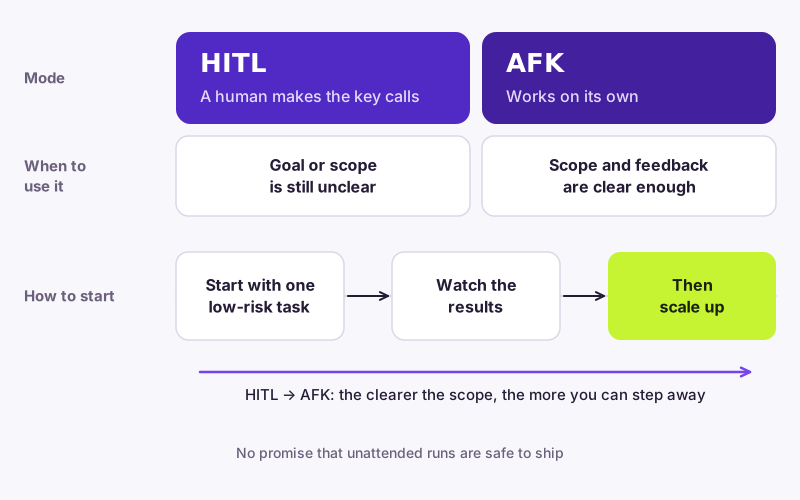
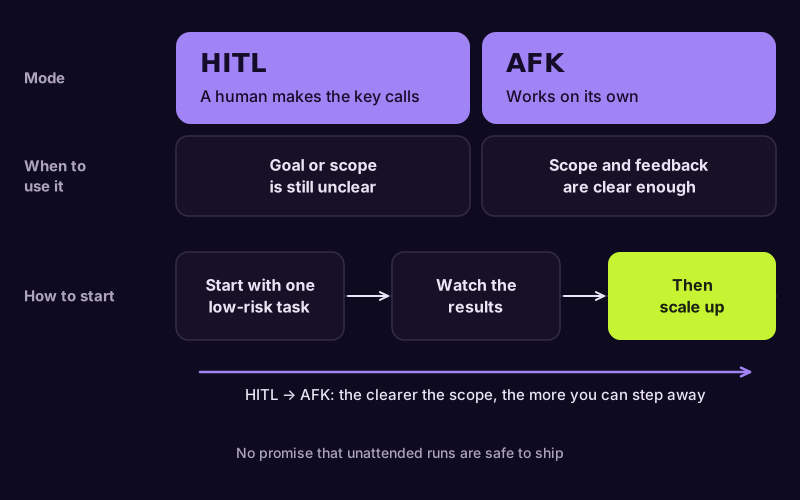
HITL means a person participates in key decisions. AFK means the agent proceeds independently once task boundaries and feedback are sufficiently clear. Keep a person involved when goals, scope, or acceptance still require judgment.
Fix the environment your agent runs in
— Matt Pocock
Match each check to a question
A TypeScript project may need type checking, relevant tests, formatting, and lint. Interactive behavior also needs an operable development server, readable logs, or a smoke-test CLI. Choose feedback that addresses the actual risks.
| Question | Useful feedback | Remaining concern |
|---|---|---|
| Do type relationships hold? | Type checking | External data and runtime behavior |
| Does key behavior meet expectations? | Relevant tests and a smoke CLI | Exceptional paths |
| Does the interface respond correctly? | Development server and readable logs | Results of real interaction |
| Are format and conventions satisfied? | Formatting checks and lint | Design decisions requiring context |
A check must detect a meaningful mistake
A test that repeats implementation logic may reproduce the same mistake. State the bad behavior that should fail, then establish whether the check catches it. If a design boundary can prevent that class of error, improve the boundary too.
Keep the necessary behavior checks to confirm what users observe. A passing result supports the properties it actually examines; other risks still require judgment.
Start automation with one low-risk task
Observe evidence and rework from a small task before expanding automation. Ralph loops offer historical context, and Sandcastle offers a tool entry point. Neither establishes that unattended releases are reliable.
Exercise: record three stages of evidence
Predict what the interface and logs should show when the service address is missing. Arrange a failing run and a run after the repair using the same input. A final screenshot alone leaves the original defect untested.
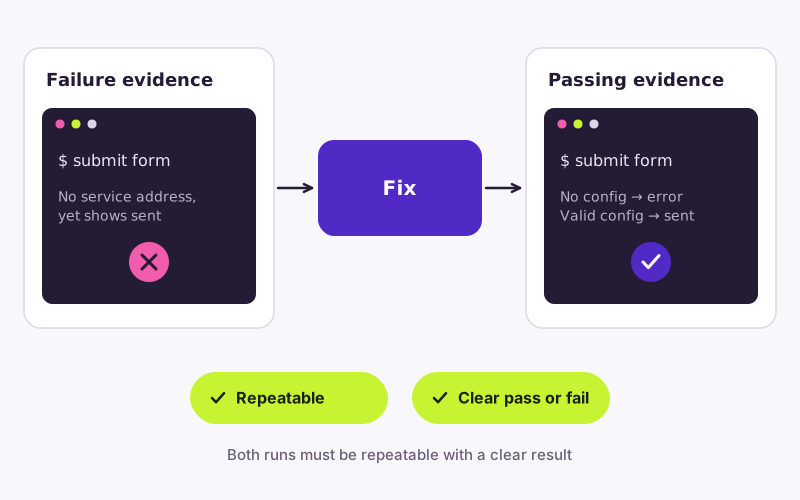
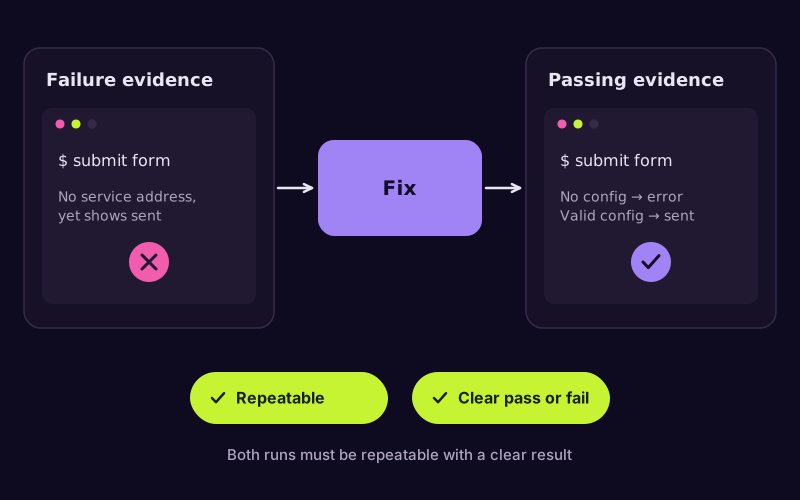
Reproduce false success and verify the repair
- Failure evidence: remove the service address in a test environment, submit the form, and record the incorrect confirmation.
- Repair: return an explicit failure for invalid configuration, preserve input, and permit retrying.
- Passing evidence: show an error under the same conditions, then restore configuration and record a real successful submission.
- Repeatability: document startup, configuration conditions, input, and expected output without recording credentials.
Suggested approach
Use the same input and state each run's configuration. Demonstrate both the absence of false success and a working valid path. Logs help locate the fault; interface results establish what the user sees.
What counts as done?
A collaborator can repeat the runs and decide whether they passed. Failure evidence, repair, and passing evidence correspond to the same behavior. Record any unrun checks as verification gaps before moving into review and PR.
Quick reference
Set an expectation
Reproduce a defect or define observable new behavior.
Use meaningful checks
Catch real mistakes and preserve valid paths.
Deliver evidence
Make runs repeatable and results decidable before expanding automation.
Sources
Independent, unofficial, noncommercial study notes. This site has no affiliation with or endorsement from Matt Pocock. Referenced works belong to their authors; MIT reuse carries separate copyright and license notices.