Can the next session find yesterday's decisions?
Yesterday you agreed that a failed save should preserve the form input. Today a fresh session clears the form. The decision stayed in chat instead of becoming an accessible reference. A sprawling spec can cause a similar problem by burying the useful choices.
The job of a spec is to carry decisions forward. A new session should be able to find what is settled, what remains open, and what evidence completion requires.
Capture confirmed behavior
Describe the goal, expected behavior, exclusions, and acceptance method. If synchronization remains undecided, label it as an open question. A document's apparent completeness should never turn a guess into an instruction.
Goal and behavior
Who needs what, and how should the system respond?
Boundaries and unknowns
What is excluded, and what still needs a decision?
Acceptance
Which actions and results would demonstrate the behavior?
They're just a projection of the decisions made during grilling.
— Matt Pocock
Connect one working path first
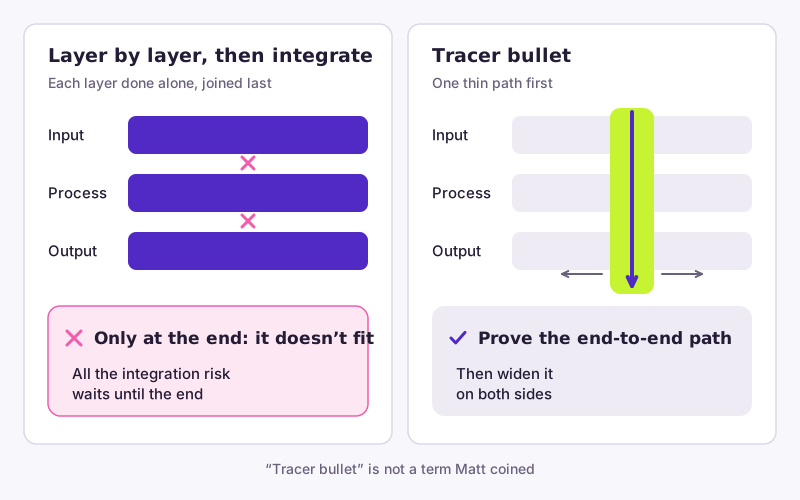
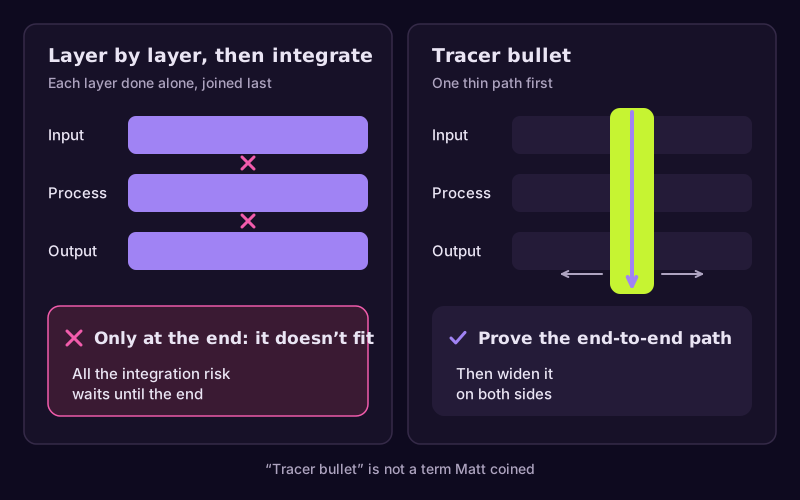
/to-spec gathers settled choices. /to-tickets divides the work into small vertical capabilities. Begin with a narrow implementation that connects input, processing, and output. Establish that the path works before extending it.
This thin working path is often called a tracer bullet, a term that predates Matt. It exposes integration questions early, while there is still little implementation to change.
Give working material a retention policy
Matt's practice favors tickets in a tracker, cleaning up specs after use, and retaining durable decisions in ADRs. Teams with audit or collaboration needs should establish their own explicit archiving policy before removing working material.
| Artifact | Contents | Retention |
|---|---|---|
| Spec | Confirmed goal, behavior, scope, acceptance | Clean up or archive under team policy after implementation |
| Ticket | One working capability, dependencies, evidence | Follow delivery in the tracker |
| ADR | A durable decision and its reasoning | Retain and identify superseding decisions |
Exercise: choose the first favorites slice
Predict whether separate frontend, API, and storage tickets can each demonstrate a working favorites feature. Then write a ticket for one item, connecting a click to persistent state.
Make one favorite independently verifiable
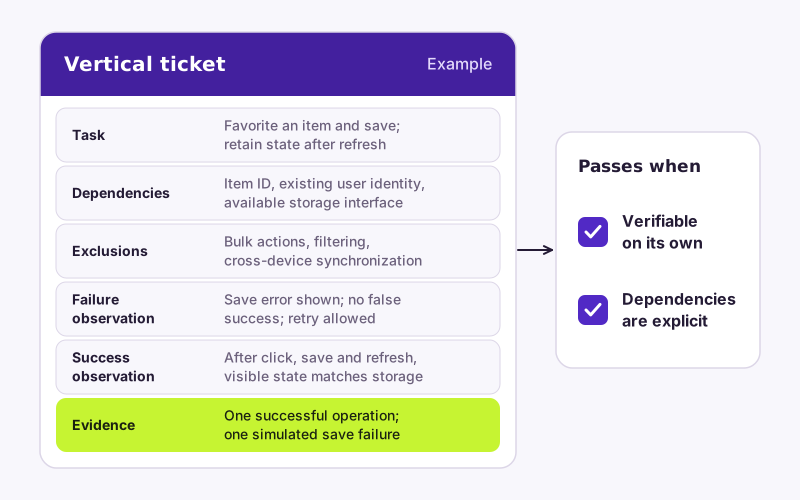
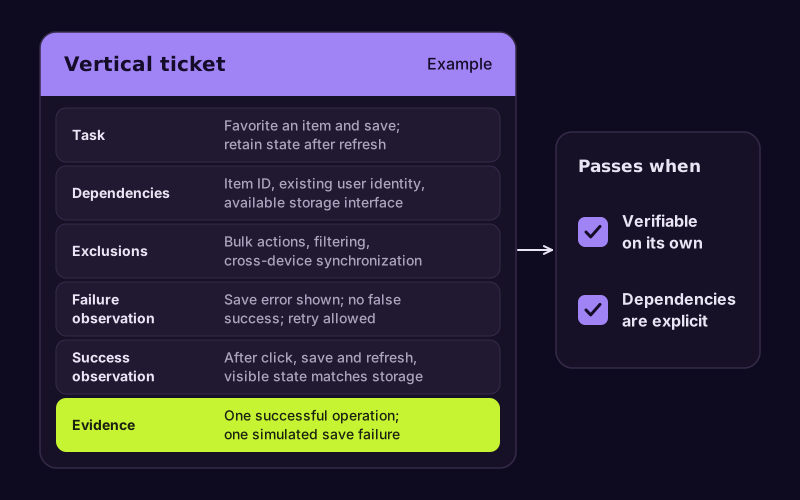
- Task: favorite an item, save it, and retain its state after refresh.
- Dependencies: an item ID, existing user identity, and an available storage interface.
- Exclusions: bulk actions, filtering, and cross-device synchronization.
- Failure observation: a failed save shows an error, avoids false success, and allows retrying.
- Success observation: after clicking, saving, and refreshing, visible state agrees with storage.
- Evidence: record a successful operation and a simulated save failure.
Suggested approach
The ticket covers input, processing, and output. If the interface is missing, identify a prerequisite or include the minimal interface in this slice. The result still needs to be demonstrable on its own.
What counts as done?
Deliver an independently verifiable ticket with explicit dependencies, success and failure observations, and an evidence location. Someone should be able to execute it without rereading the chat. Unconfirmed choices remain visible.
Take the ticket into implementation and feedback and produce the actual acceptance results.
Quick reference
Specs carry choices
Separate settled decisions from unknowns and specify acceptance.
Tickets deliver capabilities
Connect input, processing, and output early.
ADRs preserve reasons
Manage durable knowledge separately from working material.
Sources
Independent, unofficial, noncommercial study notes. This site has no affiliation with or endorsement from Matt Pocock. Referenced works belong to their authors; MIT reuse carries separate copyright and license notices.